


How to Choose a Website Development Company in Australia
(Without Wasting Thousands of Dollars)
Choosing the right website development company in Australia is one of the most important decisions for small businesses, tradies, medical clinics, and professional consultants. A professional website is a valuable business asset, but comparing agencies, pricing models, and technical capabilities isn’t always straightforward. This independent buyer’s guide explains how to compare providers, identify hidden costs, and make informed decisions before investing in a new website.
Why Choosing the Right Website Development Company in Australia Can Save You Thousands
Choosing the right website development company involves more than comparing attractive portfolios. It’s equally important to evaluate transparency, technical capability, communication, and how well the company understands your business goals.
Common Australian Small Business Mistakes
The Australian digital landscape contains thousands of service providers, ranging from solo operators to multi-state digital agencies. The most frequent error local business owners make is prioritizing the initial visual pitch over underlying technical capabilities and contractual clarity.
Some businesses report experiences where the team presented during the sales process differs from the team delivering the project. For this reason, it’s important to ask who will actually be working on your website, how communication will be handled, and whether development work is completed in-house or through external contractors before signing a contract.
Buying into Proprietary Content Management Systems (CMS): Some website providers use proprietary platforms that can make future migration more difficult. Before committing to a website project, ask whether you will retain ownership of your website content and whether the platform can be transferred to another provider if your business needs change.You are forced to pay for a complete rebuild from scratch because you do not own the underlying code.
Confusing Graphic Design with Digital Engineering: A graphic designer can build a visually striking layout that fails fundamentally as a commercial tool. If the site code is bloated, lacks semantic HTML layout structures, or ignores conversion rate optimization (CRO), it will fail to generate customer inquiries.
Real Cost of Poor Website Decisions
When a website development company’s project in Australia fails to meet expectations, the financial impact goes far beyond the initial investment.
Consider this hypothetical example. An established Australian service business invests in a new website with an expected eight-week delivery timeline. If the project is significantly delayed because of unclear scope, slow approvals, or communication issues, the overall cost can extend well beyond the original website budget through lost opportunities, additional marketing costs, and the need for further development work:
Sunk Capital: If a project does not progress as expected, any upfront payment already made may become difficult to recover depending on the agreement with the provider.
Wasted Marketing Budgets: Running Google Ads or Meta campaigns to a slow, confusing, or poorly optimized landing page destroys your conversion rate, throwing your advertising spend down the drain.
Opportunity Cost: Every week of delay is another week where high-value local leads are captured by competitors whose platforms function flawlessly.
Rectification Costs: Fixing an incomplete or poorly delivered website can require additional investment, especially if another provider needs to rebuild sections of the project or resolve technical issues. The final cost depends on the condition of the existing website and the amount of work required.
Expert Tip: A modern business website should support your marketing goals, provide a good user experience, and follow current technical best practices. If a provider cannot clearly explain how their development approach supports website performance, search visibility, security, and future scalability, ask more questions before making a decision.
Key Takeaways
Vague contracts and slick sales pitches regularly hide poor technical execution and outsourced development.
Proprietary platforms lock your business into permanent relationships with agencies, stripping you of digital asset flexibility.
The real cost of a failed website includes sunk cash, wasted marketing spend, and missed revenue opportunities.
How to Compare Website Development Companies in Australia
When comparing website development quotes, don’t focus only on the final price. Ask each provider to explain exactly what’s included so you’re comparing like-for-like proposals. A detailed quote should clearly outline design, development, content, SEO, integrations, testing, and ongoing support, helping you avoid unexpected costs later.
Understanding Pricing Structures
Website pricing in Australia varies because every agency follows a different pricing model, project scope, and service offering. Understanding what’s included in each proposal makes it much easier to compare quotes fairly.Rather than comparing quotes based only on price, review how each provider allocates its budget across strategy, design, development, content, SEO, testing, and post-launch support. A detailed proposal makes it easier to understand the value behind the investment.
Fixed Price vs. Hourly Pricing
The contractual framework you choose dictates your exposure to unexpected cost updates during production.
| Pricing Model | Pros | Cons | Best Suited For |
| Fixed-Price Website Contract | Absolute cost certainty; the agency bears the financial risk of internal operational delays. | Rigid parameters; any minor change outside the initial agreement requires a formal variation invoice. | Tradies, clinics, and local services with clearly defined requirements. |
| Hourly Agency Rates | Complete flexibility to pivot design choices and add technical features during the build. | High budget unpredictability; zero incentive for the developer to work efficiently. | Startups and enterprise platforms building unproven software or complex products. |
Questions to Ask Before Accepting a Quote
Before signing an agreement with a web design company australia, put these direct questions to their assessment team to verify their pricing transparency:
“Does this quote include professional copywriting, asset selection, and custom icon design, or am I expected to provide all content?”
“What is your precise hourly rate for work that falls outside this initial scope of work?”
“Are all software licenses, form builders, and security certificates included in this figure, or will I be billed for them separately?”
Key Takeaways
Opaque quotes often lead to budget creep; demand a clear line-item breakdown for every project stage.
Fixed-price agreements protect small businesses from paying for an agency’s internal operational delays.
Always confirm who is writing the website copy to avoid major, unexpected content fees later.
Hidden Fees Most Website Companies Do Not Explain
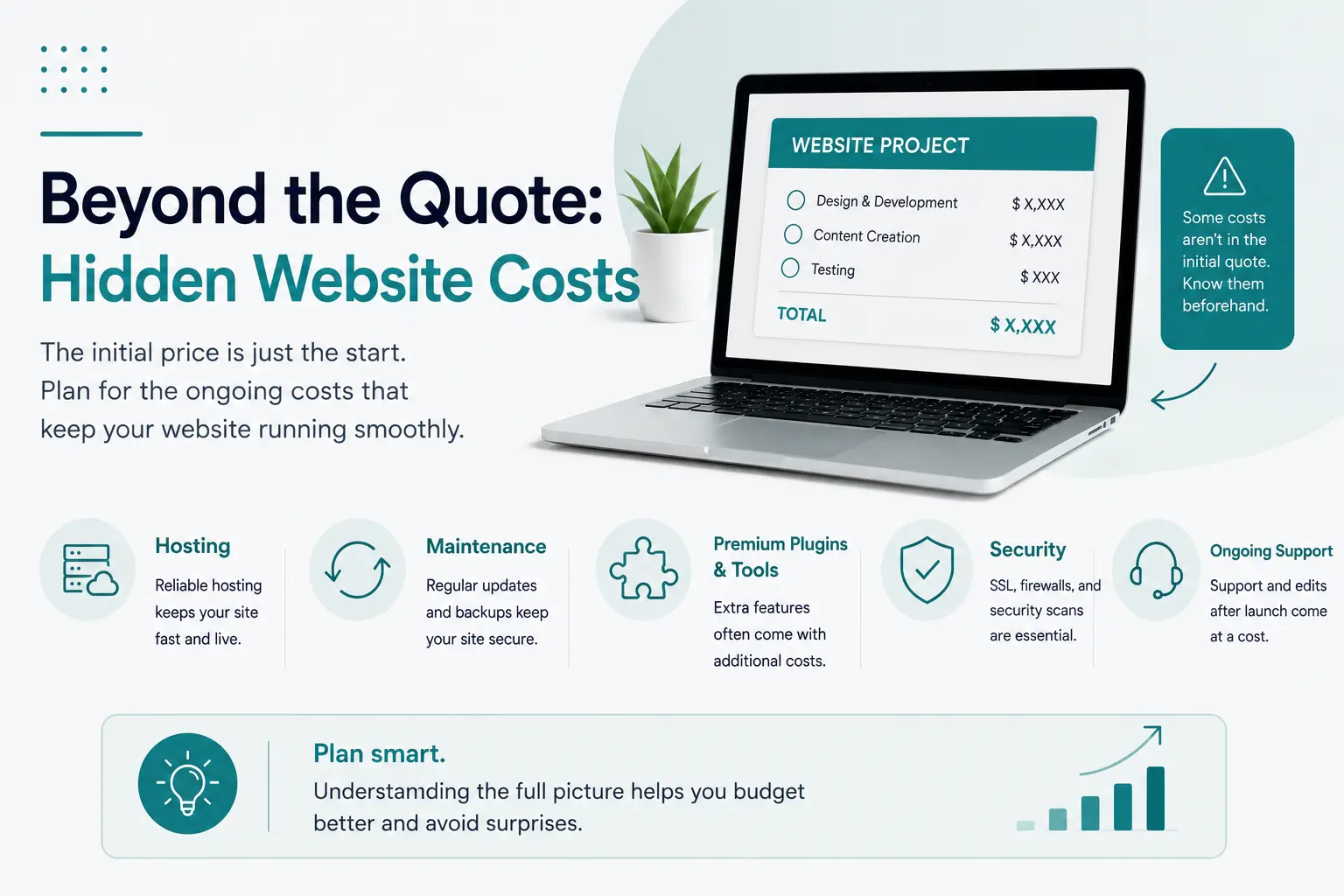
The initial website quote is only part of the overall investment. Before choosing a website development company, take the time to understand any ongoing costs, including website maintenance, hosting, premium software licences, security updates, and future support. A clear proposal should explain what’s included upfront and which services may involve additional charges later.
Maintenance Costs
Ongoing website maintenance is usually offered as a monthly service, with pricing based on the level of support your business requires. For many Australian small businesses, maintenance plans start at around AU$150 per month, while websites with more complex functionality or higher support requirements may cost more. Depending on the provider, a maintenance plan may include software updates, security monitoring, backups, uptime monitoring, hosting support, and technical assistance.
Hosting Costs
Web hosting infrastructure directly impacts your site loading speeds and security. Hosting quality varies significantly between providers. Before signing a contract, ask where your website will be hosted, what level of performance monitoring is included, and whether the hosting environment is optimized for Australian visitors. For Australian small businesses, reliable managed cloud hosting with Australian or nearby Asia-Pacific data centres can improve website performance, reduce latency, and provide a better experience for local visitors.
Plugin and Software Costs
Modern content management systems rely on external software extensions to handle advanced tasks like complex booking engines, advanced multi-step forms, and automated security firewalls. Some premium plugins and software licences require ongoing renewals. Before signing a proposal, confirm which licences are included, who owns them after launch, whether renewals are covered, and what happens if they are not renewed.
Scope Creep Charges
Project scope creep happens when new features or changes are requested after the original scope has been approved. Additional work outside the agreed scope may be charged separately depending on the agency’s pricing model and the complexity of the requested changes. Before the project begins, ask how scope changes are approved, quoted, and documented to avoid unexpected costs later.
The figures below are an illustrative example only. Actual costs vary depending on project requirements and provider.
| Potential Additional Cost | Example |
|---|---|
| Premium software licences | May require annual renewal |
| Website maintenance | Usually charged separately |
| Custom integrations | Often quoted separately |
| Scope changes | May increase the final project cost |
Every provider structures pricing differently. Always ask for a complete breakdown of one-time costs, ongoing subscriptions, maintenance, and any charges that may apply if the project scope changes.
Key TakeawaysAlways ask for a complete list of ongoing software license costs before signing a contract.
Make sure your hosting infrastructure uses local Australian data centers to keep loading speeds high.
Establish a clear process for handling scope adjustments upfront to avoid unexpected variation bills.
Freelancer vs. a Website Development Company in Australia: Which Is Better?
The right choice depends on your project’s complexity, long-term business goals, available budget, and the level of ongoing support you expect after launch.
Advantages and Potential Limitations of Freelancers
An independent website developer australia usually works out of a home office with low overhead costs.
Advantages: Freelancers are often a good fit for smaller projects because they can offer lower upfront costs, direct communication, and greater flexibility. However, pricing, availability, and long-term support can vary significantly from one freelancer to another.
Potential Limitations: Single-point-of-failure risk. If your freelancer falls ill, changes careers, or takes on a major corporate contract, your website support channel disappears instantly. Furthermore, individual developers rarely specialize in custom UX/UI layout design, backend database engineering, and advanced search engine optimization all at once.
Advantages and Potential Limitations of Agencies
A structured web development company australia brings a multi-disciplinary team to your project.
Advantages: Access to dedicated specialists, including user-experience designers, system engineers, professional copywriters, and search engine strategists. They provide robust testing processes, enterprise-grade security, and reliable post-launch support.
Potential Limitations: Higher initial capital requirements (typically AU$6,000 to AU$30,000+) and structured communication lines that can feel slower or more corporate to very small businesses.
Which Option Fits Different Business Types
| Business Category | Recommended Partner | Primary Structural Reason |
| Local Tradies & Solo Operators | Experienced Local Freelancer | Simple lead-generation needs; requires low overhead costs and direct, informal communication channels. |
| Medical Clinics & Service Providers | Specialized Digital Agency | Requires strict data privacy compliance, advanced booking system integrations, and reliable long-term support. |
| Consultants & Professional Services | Specialized Digital Agency | Demands premium branding, expert copywriting, and advanced search engine positioning to win corporate contracts. |
| Ambitious Startups & E-Commerce | Full-Stack Web Development Firm | Requires scalable, custom database architecture, high security, and ongoing technical development teams. |
Key Takeaways
- Freelancers offer cost-effective options for straightforward informational sites but carry single-point-of-failure risks.
Agencies provide reliable infrastructure and multidisciplinary teams, making them ideal for high-growth businesses.
Base your choice on your operational complexity and how much you rely on digital lead generation.
How to Evaluate Portfolios, Testimonials and Agency Processes
When reviewing a developer’s portfolio, look beyond attractive screenshots. Reviewing live websites and checking their real-world performance will give you a much clearer picture of the agency’s technical capabilities. This verification confirms whether their engineering holds up under real-world conditions.
What a Strong Portfolio Looks Like
A highly capable website design australia provider should display a diverse range of case studies that highlight actual business problems they have solved. When reviewing a portfolio, don’t just look at screenshots.Request direct links to live websites they have built. Reviewing recent projects from an agency’s portfolio provides a much better understanding of its design quality, technical capability, and industry experience.
Once you open a live site, check three critical performance factors:
Mobile Navigation Flow: Open the site on your smartphone. Does the menu function smoothly? Are the call-to-action buttons easy to press with a thumb?
Code Optimization: Run the client’s web address through the free Google PageSpeed Insights tool. Run the client’s website through Google PageSpeed Insights. If the mobile performance score is consistently low, it may indicate technical issues that should be investigated further. , the developer is delivering bloated, unoptimized code.
Real Attribution: Scroll to the very bottom of the live site. The footer should feature a credit link back to the web development company australia you are vetting, if available, this may indicate they were involved in developing the website.
Red Flags in Testimonials
Be skeptical of generic, unverified five-star text reviews displayed on an agency’s own home page. Look for these warning signs:
Vague, Non-Specific Feedback: Reviews like “Great company, highly recommend!” without mentioning the project scope, specific team members, or actual business results often signal generic or unverifiable reviews.
Lack of Real Identities: If a testimonial lacks a full name, a verifiable company name, or a link to their live platform, treat it with caution.
No Third-Party Verification: Always cross-reference reviews against independent platforms like Google Business Profiles, Clutch.co, or ProductReview.com.au. Look closely at how the company responds to past client criticisms.
The Discovery Phase Checklist
A reliable web development company australia will run an extensive discovery phase before presenting a final contract. Use this checklist to evaluate their onboarding process:
| What to Ask | Why It Matters |
|---|---|
| Do you research my competitors and target audience? | Understanding your market helps create a website that supports your business goals rather than using a generic template. |
| How do you plan the customer journey? | A well-planned website should guide visitors towards enquiries, bookings, or purchases. |
| How will my website content be managed? | Clarify whether you’ll use WordPress, Webflow, or another CMS and how easy it will be to update content. |
| Will third-party tools need to be integrated? | Confirm whether CRM systems, booking software, payment gateways, or marketing tools are included in the scope. |
| Can you explain your development process? | A clear roadmap helps you understand project milestones, timelines, and responsibilities before work begins. |
Key TakeawaysAudit live websites from the developer’s portfolio using Google PageSpeed Insights to verify their technical standards.
Cross-reference on-site testimonials against third-party review platforms to ensure they are authentic.
Avoid companies that send out generic proposals without a deep discovery conversation about your business goals.
Why Australian Businesses Are Nervous About Paying Large Deposits
Protecting your business cash flow starts with understanding how different payment models work and choosing one that matches your level of risk and confidence. Many business owners feel deep anxiety when asked to hand over thousands of dollars before receiving any tangible proof of capability.
Traditional Agency Models
For decades, the web design industry has operated on a rigid payment structure: The upfront deposit.
Under this setup, an Australian business owner must commit thousands of dollars based on nothing more than a sales pitch, a static text proposal, and abstract promises. This model puts the entire financial risk on the buyer. Once that initial cash deposit clears, the agency holds all the leverage. If their internal communication slips, their design direction misses your brand identity, or their development timeline stalls, your capital remains locked with an uncooperative vendor.
The Risks of Paying Before Seeing Design Work
This upfront financial requirement creates significant friction for local service businesses, tradies, and medical practices. It asks you to pay for a creative product before confirming that the agency truly understands your operational workflow, brand aesthetic, and conversion goals.
This model often leads to frustrating, bureaucratic revision loops where the client spends months trying to fix a layout that was wrong from day one.
| Traditional Process | A More Transparent Approach |
|---|---|
| Sign a contract and pay an upfront deposit. | Start with a discovery call to understand your business goals. |
| Wait several weeks before seeing the first design concept. | Review a custom concept or prototype early in the project. |
| Limited visibility during development. | Receive regular updates and opportunities to provide feedback. |
| Major revisions may happen late in the project. | Validate the direction early, helping reduce unnecessary rework. |
| Final website is delivered after development is complete. | Move forward with confidence once the proposed solution meets your expectations. |
How Modern Risk-Reduction Models Work
To solve this clear industry problem, some website development companies are shifting toward transparency and shared accountability. Instead of demanding a blind financial commitment, these forward-thinking providers choose to demonstrate their value first. They invest their own development hours into researching your local market competitors, mapping out user journeys, and building an actual, functioning home-page prototype before asking for a single dollar of your budget.
See Your New Website Before You Spend AU$1
This modern approach is best represented by the risk-reduction concept: “See Your New Website Before You Spend AU$1.”
This isn’t a cheap marketing gimmick or a basic template demo; it is an objective, value-first partnership model. By providing a custom, high-fidelity digital concept tailored directly to your business before any contract is signed, the risk is completely removed from the business owner.
You can judge your potential digital partner on tangible proof: their actual code performance, design quality, and understanding of your commercial goals. If the concept misses the mark, you walk away without spending a cent of your business capital, allowing businesses to evaluate whether the provider is the right fit before making a financial commitment.
Structural Comparison of Risk Models
| Project Characteristic | Traditional Agency Approach | Modern Risk-Reduction Approach |
| Upfront Financial Risk | High; 50% deposit required before any custom work starts. | Zero; no financial commitment required to review your concept. |
| Proof of Capability | Abstract promises, static portfolios, and sales documents. | A live, custom prototype tailored to your target market. |
| Project Momentum | Often delayed by slow onboarding and billing processes. | Highly accelerated; design alignment is established on day one. |
| Client Leverage | Low; your money is tied up, making it hard to change vendors. | High; you retain full control over your budget decisions. |
Key Takeaways
The traditional 50% deposit model places all financial risk on the business owner.
Modern, risk-reduction approaches show you live design prototypes before requiring any budget commitment.
Evaluating a real concept upfront eliminates long revision loops and ensures your brand is perfectly aligned from the start.
How to Avoid Website Project Delays
Website projects are far more likely to stay on schedule when both the client and the development team follow a clear process, communicate regularly, and prepare key materials before development begins.
Content Bottlenecks
The single greatest cause of website project delays is content asset collection. Most business owners underestimate how long it takes to write professional copy, capture high-resolution imagery, and gather team profiles. If your agreement states “Client to supply all content,” the agency will pause your project the moment their developers run out of assets. To protect your launch date, either hire an agency that includes professional copywriting or ensure all your materials are organized before production starts.
Approval Delays
When design concepts or functional wireframes are submitted for client review, internal approval delays can stall project momentum. If a proposal sits with your management team or clinical board for two weeks before feedback is provided, the agency will reallocate their developers to other active accounts. This can push your launch date back by months. Establish a dedicated internal project owner who can deliver unified feedback within a strict 48-hour window.
Scope Creep Management
When a project is underway, it is natural to think of new features, such as adding a custom calculator or expanding a resource library. However, introducing adjustments mid-build disrupts the core code development structure. Every unmapped feature addition requires a formal stop-work assessment, quotation adjustments, and custom adjustments. This can completely derail a production schedule. Save non-essential feature ideas for a planned “Phase 2” release after your core platform goes live.
| Recommendation | Why It Matters |
|---|---|
| Prepare your content early | Gather your logo, brand assets, images, website copy, and login credentials before development starts. |
| Assign one decision-maker | Having a single point of contact helps speed up approvals and reduces communication delays. |
| Keep the project scope focused | Finalise the core features before development begins. New ideas can be added after launch as future improvements |
Key TakeawaysGathering content is the most frequent project bottleneck; settle your copy and imagery early.
Appoint a single internal project owner to handle all communication and prevent feedback delays.
Lock down your core features before production begins, saving new ideas for post-launch updates.

Modern Website Standards Australian Businesses Should Expect in 2026
A modern business website should be built using current technical standards, accessibility best practices, and a structure that supports both search engines and AI-powered search experiences.
Mobile Responsiveness
With more than 65% of Australian consumer web traffic now originating on mobile devices, basic desktop-centric design is obsolete. Your platform must be engineered using a mobile-first approach. This means navigation menus must be touch-optimized, media files must scale fluidly without causing layout shifts, and data entry forms must be easy to fill out on small screens.
Core Web Vitals
Google considers Core Web Vitals as one of several signals used to evaluate page experience. While they are not the only ranking factor, improving these metrics helps create a faster, more reliable website and supports long-term search visibility. Your website development partner should optimise the following Core Web Vitals:
Largest Contentful Paint (LCP): Measures loading speed. visible content must display within 2.5 seconds of a user clicking your link.
Interaction to Next Paint (INP): Measures user responsiveness. The platform must respond to actions (like button clicks) within 200 milliseconds.
Cumulative Layout Shift (CLS): Measures visual stability. Page elements must not shift unexpectedly during loading, preventing accidental clicks.
Accessibility Standards
Australian business platforms face increasing requirements to comply with the Web Content Accessibility Guidelines (WCAG). Ensuring your site features high color contrast ratios, screen-reader accessible alt text, and keyboard-navigable menus expands your market reach to users of all abilities and protects your business from consumer discrimination risks.
Website Security
Data protection is non-negotiable for modern businesses, especially for medical clinics handling patient info or consultancies holding corporate data. Your site must feature an active SSL certificate, secure database communication protocols, a robust content-security policy, and automated daily backup routines.
WordPress vs. Webflow
Choosing the right software infrastructure impacts your long-term platform management flexibility.
WordPress: WordPress powers more than 43% of websites globally, making it the world’s most widely used content management system. It offers unmatched open-source adaptability, deep plugin options, cost-effective scaling, and excellent local SEO management. It requires active maintenance but provides greater ownership and flexibility of your site files.
Webflow: A modern cloud-based visual development platform. It features clean code output, fast hosting, and removes the need for plugin updates. However, it requires specialized platform management skills and carries ongoing platform subscription costs.
Generative Engine Optimisation (GEO)
The search environment has evolved beyond traditional keyword matching. Modern consumers regularly look for local services using AI platforms, voice assistants, and conversational tools.As AI-assisted search becomes more common, websites should be built with both Generative Engine Optimisation (GEO) and Answer Engine Optimisation (AEO) in mind. This helps make content easier for both search engines and AI-powered search experiences to understand.
| Traditional SEO | Generative Engine Optimisation (GEO) |
|---|---|
| Focuses on improving visibility in Google search results. | Helps content become easier for AI-powered search experiences to understand and reference. |
| Optimises keywords, metadata, and page structure. | Emphasises clear content structure, entities, schema markup, and direct answers. |
| Success is measured by rankings, traffic, and clicks. | Success also includes improving the likelihood that content can be understood and surfaced in AI-powered search experiences. |
| Designed primarily for search engine crawlers. | Designed for both search engines and AI systems that summarise and recommend content. |
| Encourages users to click through to the website. | Aims to make content clear, well-structured, trustworthy, and easier for AI-powered search experiences to interpret. |
Traditional SEO and Generative Engine Optimisation (GEO) work best together. Traditional SEO focuses on improving visibility in search engine results, while GEO helps structure your content so it is easier for AI-powered search experiences to understand and reference. A modern business website should be optimised for both.
To improve visibility across AI-powered search experiences such as Google AI Overviews, ChatGPT, Gemini, Claude, and Perplexity, consider the following best practices:
Structured JSON-LD Schema Markup: Explicitly defines your business entity, location parameters, service descriptions, and operating hours in a machine-readable format.
Semantic Content Layouts: Semantic Content Layouts: Organising information into clear heading structures (H2, H3) that answer common customer questions and make content easier to understand.
Authoritative Entity Citations: Linking your digital infrastructure directly to your verified Google Business Profile and recognized local industry directories.
Key Takeaways
Fast mobile loading speeds and high Core Web Vitals are mandatory to rank well on modern Google searches.
WordPress offers open-source flexibility and lower scaling costs, while Webflow provides hosting security.
Your code must include structured JSON-LD schema markup to ensure your business is discovered and cited by AI engines.
Expert Recommendations for Small Businesses
The Master Website Hiring Checklist
Before transferring any capital or signing an agency engagement contract, ensure you check off every item on this website hiring checklist:
- Ownership Verification: Confirm in writing that you retain 100% ownership of your domain registration, custom code repositories, graphics assets, and database files upon project completion.
- Technical Speed Audit: Run the agency’s live portfolio sites through Google PageSpeed Insights to verify their performance standards.
- Local Hosting Confirmation: Confirm your site will be hosted on local Australian servers (Sydney/Melbourne) with daily automatic backups.
- Content and Copy Clarification: Confirm exactly who is writing the copy and whether asset licensing fees are built into the quote.
- Risk-Free Concept Review: Ask if the vendor offers a modern risk-reduction path—such as an authentic Australian Website Development Service Page—allowing you to evaluate custom layouts before committing your budget.
Project Preparation Checklist
To minimize onboarding friction and keep your project moving efficiently, compile these core assets before reaching out to web development firms:
Verified Branding Assets: Gather your vector logo files, official color palettes, and corporate font guidelines.
Administrative Access Details: Secure the login passwords for your existing domain registrar account and Google Business Profile.
Clear Feature Mapping: List your mandatory integrations, such as specific clinic booking engines, CRM systems, or client payment portals.
Competitor Benchmark Analysis: Identify 3 local or international competitor websites whose layouts, features, or content approaches fit your target direction.
Conclusion
Securing an enterprise-grade website doesn’t have to involve unpredictable upfront costs or stressful project management. By learning to look past polished sales pitches, identifying hidden operational costs, and choosing fixed-price agreements, Australian business owners can confidently take charge of their digital transformation.
Some website providers are adopting more flexible engagement models designed to reduce upfront risk for clients. Partnering with a modern development team that respects your cash flow, uses local server hosting, and values transparency sets your business up for long-term growth and digital success. If you’re planning a new website, work with a development team that clearly explains its process, pricing, technical standards, and long-term support before you commit. Taking time to compare providers carefully can help you build a website that delivers long-term business value.
People Also Ask
How much should a small business website cost in Australia?
Based on published Australian pricing guides, many custom lead-generation websites for small businesses commonly fall within the AU$5,000 to AU$12,000 range. Actual costs vary depending on the number of pages, design requirements, integrations, content creation needs, and the experience level of the website provider.
Why do website quotes vary so much?
Quotes vary because agencies operate on completely different business models. Website quotes vary because providers use different delivery models, team structures, design approaches, and support levels. Lower-priced projects may focus on basic functionality, while higher-priced projects often include strategy, custom design, copywriting, integrations, testing, and ongoing support. Higher quotes reflect a team of dedicated local specialists handling custom strategy, UX/UI layout work, professional copywriting, and robust quality testing.
What is the biggest cause of website project delays?
The most frequent cause of project delays is a bottleneck in gathering content assets. Projects routinely stall when businesses take weeks or months to supply copy, logos, and imagery. This forces development teams to pause their work and reallocate resources elsewhere.
Should I hire a freelancer or an agency?
Hire a freelancer if you have a straightforward informational project, a tight budget, and want direct communication with the person coding your site. Hire an agency if you require a scalable platform, advanced software integrations, professional copywriting, and reliable long-term support.
Can I see a website mockup before paying?
Payment structures vary between providers. Some agencies begin work after an upfront deposit, while others may offer discovery workshops, wireframes, or concept reviews before a full project commitment. Businesses should review the process carefully and choose an approach that matches their risk tolerance.Some providers also offer concept reviews or prototype-based engagement models that allow clients to evaluate the direction of the project before making a full financial commitment.
What are website maintenance costs?
Website maintenance costs in Australia vary depending on the level of support required. Many providers offer maintenance plans ranging from approximately AU$150 to AU$600 per month, although larger or more complex websites may require higher support budgets. These plans often include security updates, backups, uptime monitoring, hosting support, and technical assistance.
How long does it take to build a website?
Website development timelines vary depending on the size and complexity of the project. Many Australian small business websites are completed within several weeks, while larger websites or projects requiring custom functionality, third-party integrations, or extensive content may take longer. Before starting, ask your website development company for a clear project timeline and milestone plan.
Do I own my website after launch?
Ownership depends on the agreement you sign. Before your project begins, confirm in writing that you’ll own your domain name, website files, graphics, content, and any agreed digital assets once the project is completed. Also check that you’ll have full access to your hosting account and website administration after handover. Be cautious of providers that retain ownership of your website files, lock you into proprietary platforms, or restrict access to your domain and hosting.
What should be included in a website package?
A complete small business website package should include custom responsive layouts, search-optimized copywriting, on-page SEO setup, secure forms, local cloud hosting integration, SSL certificates, schema markup, and custom training video walkthroughs.
How do I compare website development companies?
Compare companies by auditing their live portfolio sites with Google PageSpeed Insights, reading verified third-party reviews, confirming their development team is based in Australia, ensuring fixed-price terms, and evaluating their willingness to offer upfront design concepts.